Two pressure cookers
run the modern world.
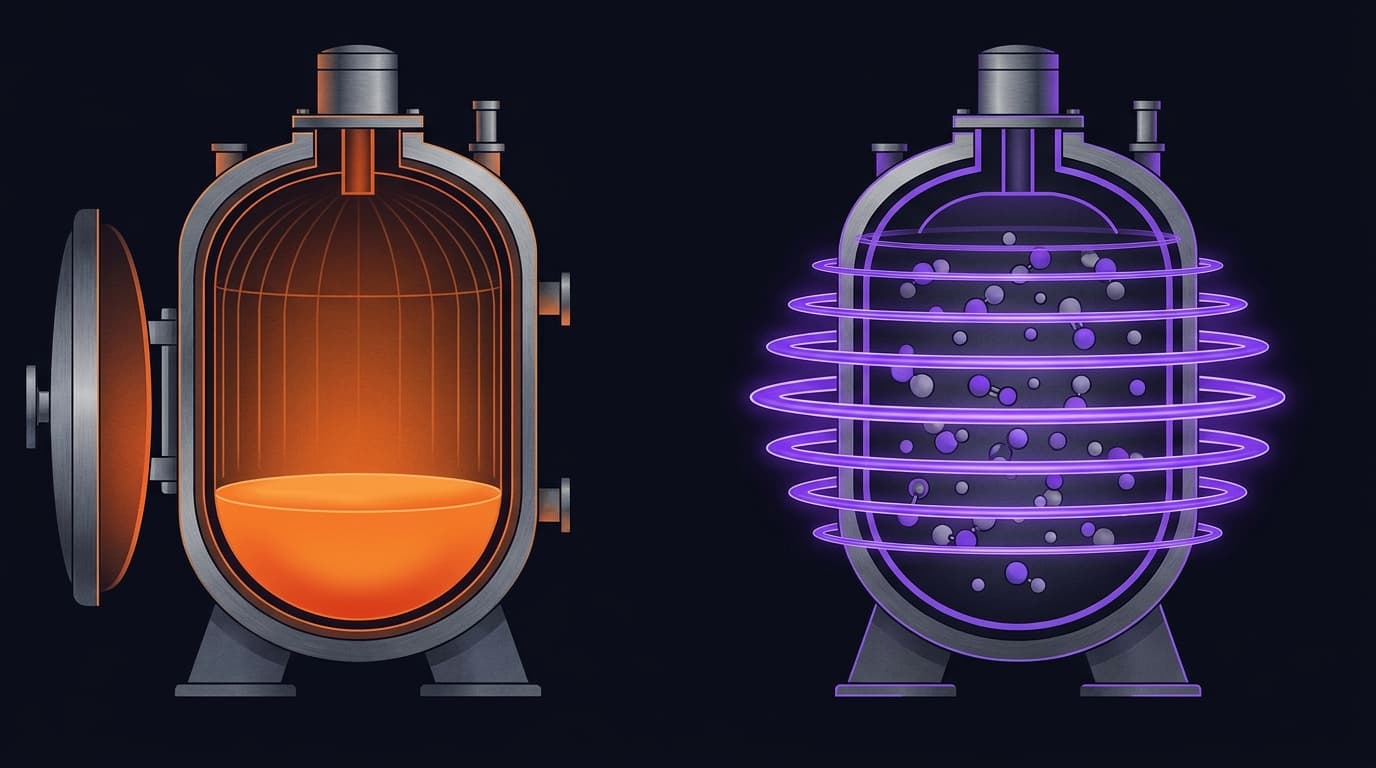
HPAL and Haber-Bosch look identical from the outside: a steel vessel, extreme heat, crushing pressure. They use that pressure for completely opposite reasons — and when you price what the pressure costs, the green route stops being the virtuous option and becomes the cheap one.
Same steel jacket, opposite physics
Haber-Bosch feeds half of humanity — roughly fifty percent of the nitrogen atoms in your body passed through one of its reactors on the way to becoming fertilizer, then food, then you.
High Pressure Acid Leaching — HPAL — is quietly deciding whether the electric vehicle transition is affordable. It unlocks nickel and cobalt from low-grade tropical dirt no smelter can touch, and it is the benchmark every "cleaner, cheaper nickel" startup has to beat.
Pressure as a bodyguard
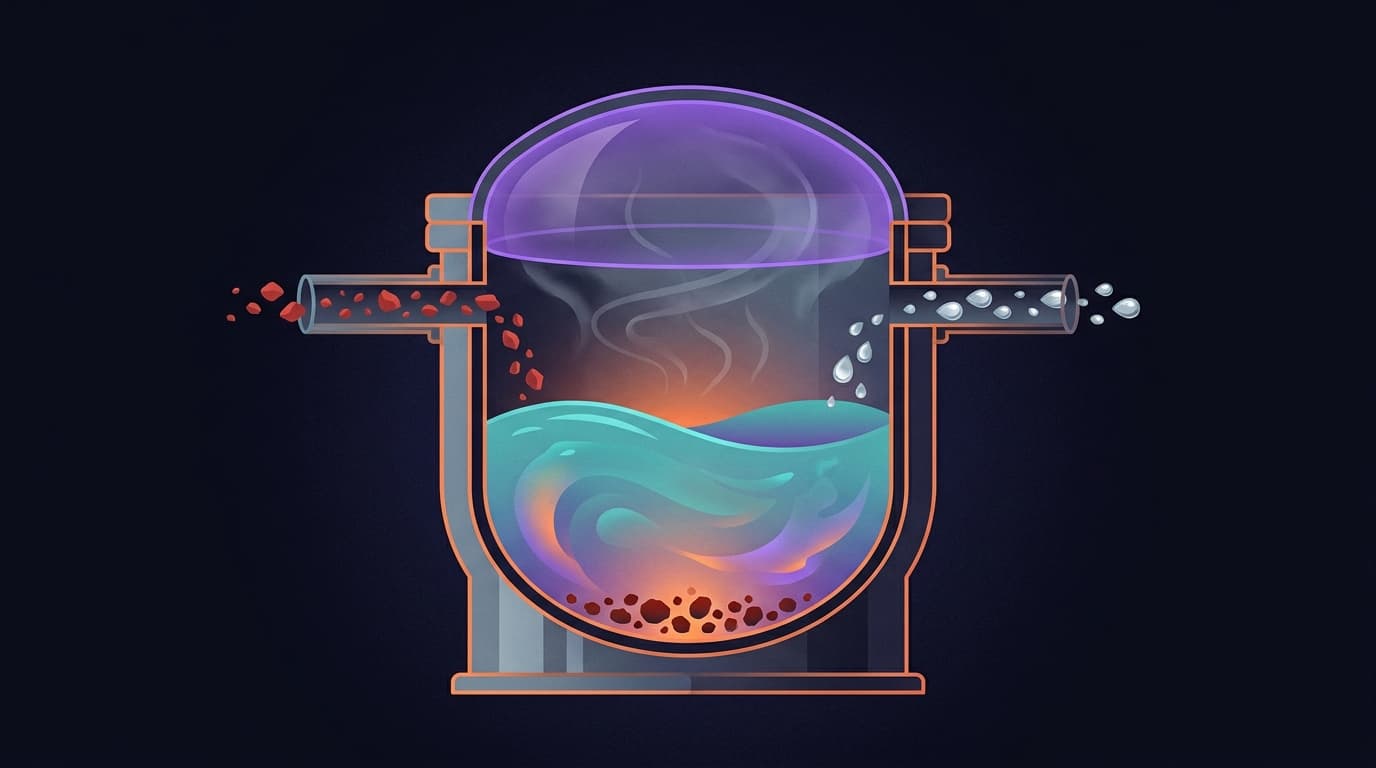
HPAL dissolves nickel and cobalt out of laterite ore. The recipe: slurry the ore with water, pump it into a titanium-lined autoclave, add concentrated sulfuric acid, heat to roughly 250°C, wait an hour.
The catch: the slurry is water-based, and water boils at 100°C. To run liquid-water chemistry at 250°C you must suppress boiling — holding the vessel at about 40 bar, the pressure of a few hundred meters of ocean depth. The pressure does no chemical work at all. It stands at the door and stops the water from leaving so temperature can do its thing.
At 250°C the acid chews through ore in an hour instead of days — and iron, which would poison the solution, spontaneously re-precipitates as hematite inside the autoclave, handing its acid back to be reused. Extraction and rough purification in a single step. That selectivity is the entire reason HPAL exists.
Pressure as the engine
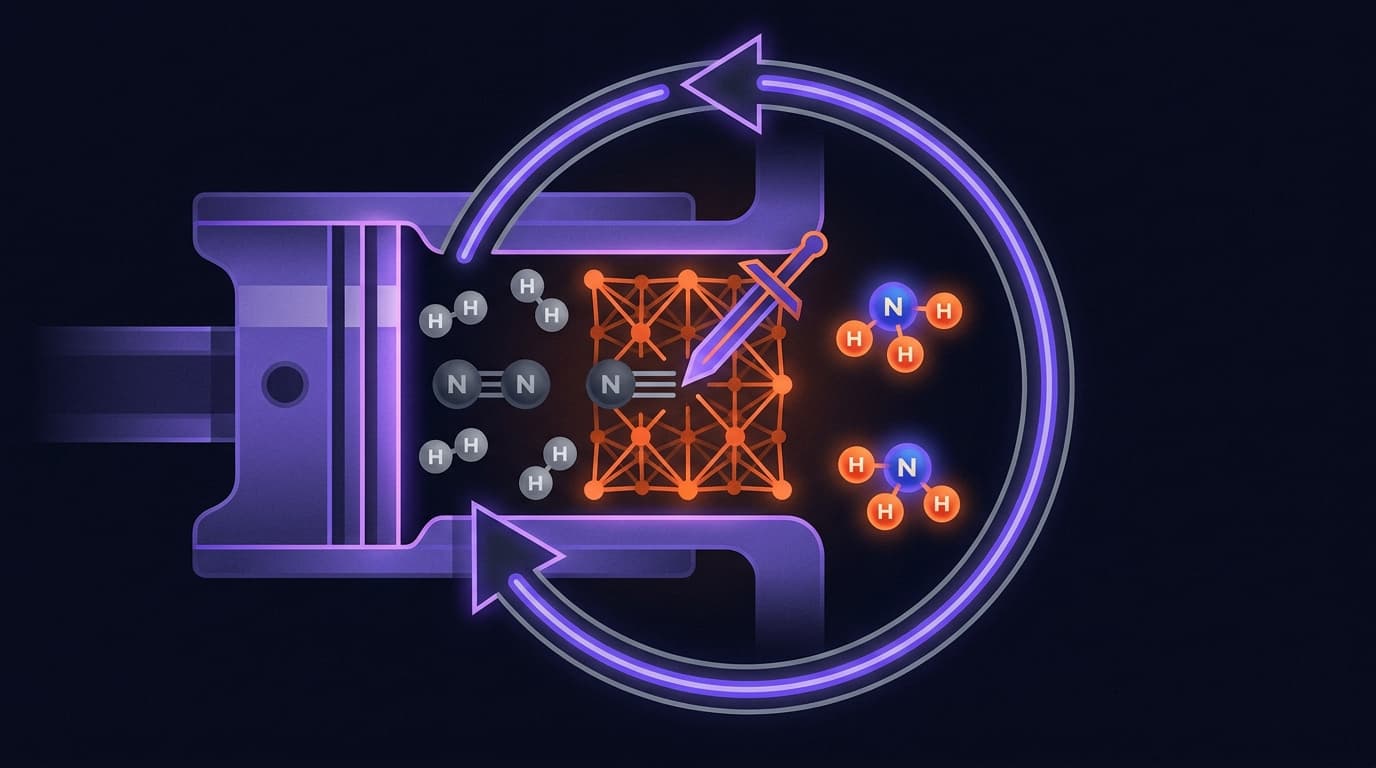
Haber-Bosch smashes nitrogen and hydrogen into ammonia: N₂ + 3H₂ → 2NH₃. Count the molecules — four go in, two come out. Le Chatelier's principle says squeezing a gas reaction shifts the equilibrium toward the side with fewer molecules. So cranking the pressure to 150–300 bar literally forces more ammonia into existence.
Its cruel contradiction: the reaction favors ammonia when cold, but nitrogen's triple bond makes cold chemistry hopelessly slow. Run hot for speed and a single pass converts only ~15% of the gas. The fix is industrial stubbornness — condense, recycle, loop, with an iron catalyst cracking the triple bond on every lap.
Fritz Haber proved it on a tabletop in 1909. Carl Bosch invented half of modern high-pressure engineering to scale it. The result rewired the planet's nitrogen cycle and detonated the twentieth century's population curve.
A shield and a sword
| Dimension | HPAL | Haber-Bosch |
|---|---|---|
| What pressure does | Nothing chemical — it suppresses boiling. Remove it and the chemistry just stops. | Everything — it shifts the equilibrium. Remove it and the chemistry collapses. |
| Temperature's role | The star: drives leaching, flips iron from contaminant to self-removing byproduct. | The villain: needed for speed, hurts the yield, demands the recycle loop. |
| Who sets the pressure | Physics — water's vapor pressure dictates ~40–55 bar. | Economics — engineers trade compression cost against yield at 150–300 bar. |
Run it as a ledger
Strip the engineering away and every extraction process is the same arithmetic: inputs + energy = outputs + tailings. Price the four terms and the romance evaporates — what's left is a ledger. For nickel the inputs are ore, sulfuric acid and limestone; the energy term is whatever it costs to hold the vessel at temperature and pressure; the output sells at the nickel price; and the tailings are a cost you pay to make go away. Here are the two ways to turn Indonesian laterite into battery-grade nickel, priced term by term, against what a tonne actually sells for.
What a tonne of nickel costs to make — and what it sells for
Cost per tonne of nickel by processing route · April 2026 input prices
Input prices: ore $15.79/wmt · sulfuric acid $150/t · reagent $400/t · limestone $50/t (Sherritt Q4 2025; Indonesian benchmarks, April 2026). Route-level comparison; HPAL benchmarks: Mining Weekly, S&P Global, Crux Investor.
Read the bars against the volt line. At April 2026 prices a tonne of nickel sells for about $15,000. HPAL's stack crosses the line: $9,400 of materials, $4,052 of energy to hold roughly 250°C and 50 bar, and $2,200 to deal with acidic tailings — $15,652 all-in. The autoclave loses about $650 on every tonne before a dollar of its multibillion capital bill is repaid.
Atmospheric leaching runs the same chemistry at 95°C and one atmosphere, in ordinary agitated tanks, in four to six hours. It spends a little more on reagents — and deletes most of the energy term and nearly all of the waste term: $13,414 all-in, roughly $1,600 of margin per tonne at the same sell price, while extracting more nickel from the same ore (85% vs 83%). The green process is not the expensive virtuous option. On this ledger it is simply the better business.
Green is the cost floor, not a premium
The instinct is to treat clean processing as a luxury good — something buyers pay extra for. The ledger says the opposite: the route with the smallest energy term and the smallest waste term is the cheapest producer at today's prices, before anyone pays a green premium. Carbon borders — CBAM, battery passports — don't create the advantage; they widen a gap that is already on the cost line. RKEF smelting emits roughly 65 tonnes of CO₂ per tonne of nickel, HPAL about 18, atmospheric routes about 10 — and foreign markets have started taxing the difference.
The tailings term can even flip sign. Atmospheric residues come out non-toxic and crystallise into ammonium sulfate, magnesium salts and agricultural gypsum — fertilizer, in a region that imports it. Ambatovy in Madagascar already sells roughly 210,000 tonnes a year of ammonium sulfate made exactly this way. The line item every autoclave operator books as a liability becomes a second product — and feeds the other pressure cooker's story.
Haber-Bosch still consumes one to two percent of global energy; HPAL still sets the cost bar for battery metals. A hundred years apart, the same lesson: when you understand exactly what the pressure is doing — and what it costs — you know where the process can bend. Both of these vessels are now the expensive way to do their own jobs. That is where breakthroughs break in.
The ladder we're investing in
That is why we're starting with two pre-A deals — one for each pressure cooker. Baniql extracts nickel and cobalt without the extreme heat and pressure, and makes the waste stream non-toxic: they didn't green the electricity, they removed the autoclave — and as the ledger above shows, that makes them the low-cost producer, not just the clean one. Living Roots attacks the other vessel's product — a biological crop system for tropical agriculture that cuts chemical fertilizer use by 50–80% for smallholder farmers across Thailand, India, and Indonesia. Chemical fertilizer is Haber-Bosch ammonia; Living Roots displaces it with biology, season by season.
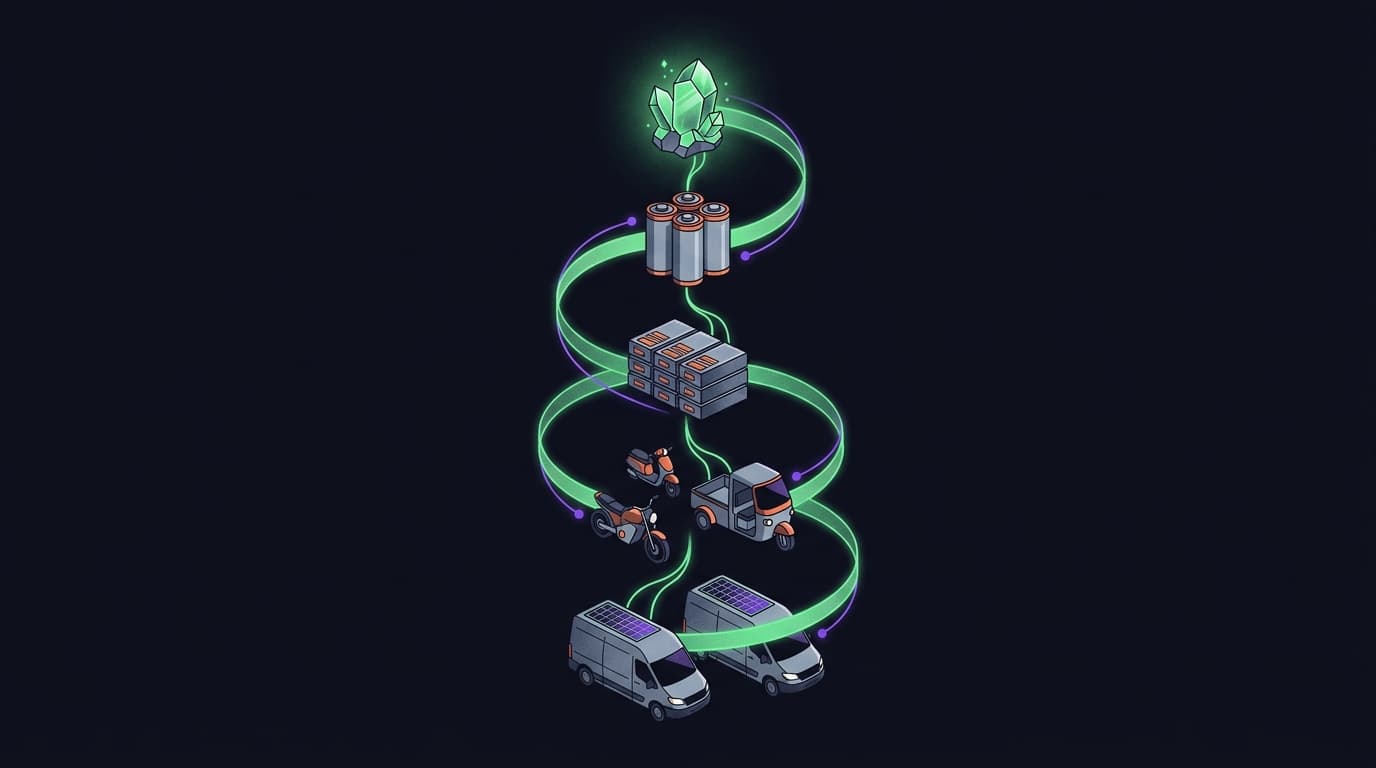
The high-tech story is the top of the chain. The rest of the chain doesn't need breakthroughs — it needs capital and know-how to climb one rung: pack assemblers becoming cell makers, CKD assemblers becoming real manufacturers of bikes, three-wheelers and cars, and the fleets delivering medicine, TVs and bulk goods going electric with solar overhead and a clean supply chain behind it.
Investing at the top of the chain secures buyers for our investments down the chain — every rung we fund strengthens the order book of the rung above it. And across the board, every transaction on the ladder is a green trade finance opportunity: short-duration, asset-backed, ESG-clean paper generated by our own portfolio's commerce.